


Earning Clicks through Blogging: Our SEO Playbook
Starting a company, bringing a product to market and finding buyers is difficult. Even though the Internet is a global, 24/7 marketplace, where hypothetically any business can reach anyone at any time, competition for clicks is incredibly fierce.
When we started our B2B SaaS business Five, we started with zero clicks, zero impressions and, admittedly, zero SEO knowledge. Yes, we had heard of Google Analytics before, but just looking at all the charts, dashboards and metrics, gave us a headache. Google Search Console Insights, another SEO essential, was entirely new to us. And tools like SEMrush, SimilarWeb or Ahrefs didn’t mean anything to us at all. We also didn’t have the budget to engage an agency, nor did we think it was the right step for us at the time. We felt like we needed to learn our own SEO lessons first before passing the baton to someone else.
So how did we manage to grow our traffic? Through strategic blogging, discipline, research, and (a lot of) trial-and-error.
In this case study, we share our SEO strategies, discuss what worked and didn’t work, and explain how we ultimately earned 1.5k clicks a day purely through blog posts and without spending a single dollar on paid ads.
Our SEO Results
Before we go into our SEO strategies and tactics, let’s look at results first.
Below is a screenshot of our Google Search Console (GSC) Insight’s performance.
If you are unfamiliar with GSC, let me briefly explain the tool’s purpose first. GSC tells you primarily four things:
- How many clicks did our website receive from Google’s organic search results?
- How many impressions did your website receive from Google’s organic search results?
- For your website’s indexed pages on Google, what is our Click-Through Rate (CTR)?
- For your website’s indexed pages on Google, what is our average position?
Out of these four metrics, clicks are the most insightful and valuable. A click means someone discovered your content, found it sufficiently interesting, and decided to click onto it, landing on your page. Increasing clicks from SEO are the ultimate confirmation of a content-driven marketing strategy.
💡 For more on GSC and why it is an SEO essential, read our “Guide to Google Search Console“.
Our GSC Data: Seeing Clicks Grow
In the chart below, we are only looking at two out of these four metrics that GSC gives us: daily clicks and daily impressions.
For example,
- On Wed, Jun 05, 2024, our website received 422 clicks from organic search.
- On Wed, Oct 16, 2024, i.e. four months later, our website received 1,334 clicks from organic search.
- That’s almost 1,000 more clicks in a single day.
Here’s the chart that shows how our traffic evolved.

The ups and downs that look like inverted Vs are typical for almost any website: traffic is weak on weekends and picks up on weekdays.
For our website, this was even more pronounced as most of our traffic comes from desktop rather than mobile. Our content was clicked on and read by people when they were sitting in front of their computer, which typically happens on weekdays during working hours.
SEMrush Data: Clicks and Keywords
Let’s look at our SEO results in another way. This time we’re looking at numbers from SEMrush, a tool popular with marketers and website owners, which became essential to us during our SEO journey.
Below are two charts. One showing our organic traffic and one showing the number of organic keywords our website is ranking on. We zoomed out to better show the overall evolution of our trafic and keywords.

Here are a few things to note:
- The Pre-Product Years: we first published our website in early 2021, prior to the release of our product. During the time, we haphazardly dabbled in SEO and maintained a blog. Without a coherent plan, it was no surprise that traffic was essentially flat.
- The Early Years: In the second half of 2022, we released a new version of our website, and put more effort into publishing SEO-friendly blog posts. From analyzing competitor websites, we picked up on keywords and topics that drove relevant trafic. However, we weren’t able to produce rapid growth.
- Generating Rapid Growth: doubling-down on what worked and throwing overboard what didn’t, we started to earn clicks consistently from approx. August 2023 onwards.
Let’s look at the 3 phases of our growth in more detail.
The Pre-Product Years
What were some of the lessons we learnt during our pre-product years?
Lesson 1: Have a Proper Sitemap
When we started our business, we had a rough idea of what our website should look like.
Our website was supposed to inform visitors about our product’s (future) features, who we are, and what we do. Most of our discussions centered on website design (colors, font sizes, logos, etc) and presentation (where to show what), and not on website structure. This was a mistake.
Rather than discussing design, we should have discussed structure. And the sitemap should have been our starting point.
Here’s why: a website is part of your marketing and sales funnel, and it typically covers all stages of the buyer journey, from discovery (someone lands on your page) to conversion (someone signs up for your product, makes a purchase, or leaves their contact details).
Your website’s structure should guide visitors towards your conversion goal. For this to happen, one of the first documents, you (and/or your web developer) need to produce is a clean, well-structured sitemap. Without a sitemap, you risk adding irrelevant pages, diluting your funnel, overcomplicating website visitors’ journeys, or worse, directing visitors into dead-ends or onto irrelevant pages.
If you are uncertain about what the ideal sitemap for your business should look like, lesson #2 gives you the shortcut.
Lesson 2: Learn From Others
As a resource-strapped start-up, time is of the essence. But solving complex or unfamiliar problems takes time.
Luckily, there are only very few problems that only you need to solve. Most problems have been solved by others already, and learning from their strategies is one of the quickest ways to succeed. This especially applies to websites, SEO and sitemaps.
Let’s speak about sitemaps first. Let’s say you are starting a new SaaS business. What should your sitemap look like? Easy. Go to three of your competitors’ websites (ideally, well-funded, Silicon Valley or Y Combinator type companies) and copy their sitemap.
This applies to every industry. Just look at your competitors’ websites, and copy their structure. If you can’t find a competitor, check out WordPress templates and themes for your industry from places like Themeforest. And if you are in e-commerce, simply choose Shopify or another e-commerce specialist to build your website.
The bigger point here is this: do not reinvent the wheel or try to be different from others where it does not make sense.
Of course, the pages on your website should look different from your competitor’s pages. But your website’s structure should be the same or at least similar.
Just like any brick-and-mortar retail store needs an entrance door, a checkout and display racks, your website needs the same pages as others in your industry. For example, if all your competitors have pages on pricing, features, case studies and use cases, then you should have the same pages.
The great thing is that websites are public documents. Let your competitors’ website speak to you. It’s the closest you will get to getting first-hand insights into their marketing strategies. For example,
- Look at the pages they make easily accessible in the top navigation. These are the important pages.
- Check the captions on the CTAs and use the same on your website.
- Pretend to be a buyer and learn how your competitors’ websites lead you down the funnel towards converting. Apply the same techniques on your website.
And as mentioned above, don’t shy away from copying from the best or most well-funded companies in your industry. Let their marketing departments work for you!
Now let’s speak about writing and publishing blog posts.
Lesson 3: Don’t Start Blogging Until You’ve Figured Out Keywords
Not every founder or business owner enjoys writing. Some prefer building product, others enjoy sales. But not everyone is a natural blogger. Worse, not everyone is a natural SEO expert.
Though we enjoy writing, one cardinal mistake we made (and one that I see all the time with small companies) is that we started publishing blog posts without researching keywords first. Don’t. It’s a massive waste of time.
Here’s why:
Your website has no authority, and unless you pick the right keywords, you are unlikely to appear anywhere near Google’s page 1. This means that all those beautiful, well-researched blog posts you are writing never get read. Your only audience is you (and maybe your colleagues, family and friends that you force to share your blog posts on their social media).
Only start writing blog posts after you have done your keyword research.
Select long-tail keywords that offer a good balance between keyword volume (you want a lot of volume) and keyword difficulty (you want low difficulty). Once you have a list of high-volume, low-difficulty keywords, start writing.
If you don’t know where to find this information, SEMrush is the answer.
Lesson 4: Use a SEO Plugin
Another common mistake is believing you are only writing for human readers. You are not.
The first (and in many cases, only) “person” to read (crawl) your blog post is Google. And only if Google comes to the conclusion that your blog post is worthy of appearing in its search results, will humans even be able to find it.
Here’ what happens after you publish a blog post and submit it to Google. Google will evaluate your blog post and make the following decisions:
- Is the quality of your blog post high enough for it to be indexed? If yes, Google will rank it and display it in its search results. If no, it won’t appear on Google and no one will ever find it.
- Assuming your blog post is well-written enough to be indexed, what keywords should it rank on? Google will analyze your headings and content.
- And for the keywords that your blog post is ranking on, what is the position it is ranking on? If it’s not on Google’s first page, it is unlikely to ever be clicked on.
In other words, a lot of blog posts that get published simply never get clicked on, read or acted upon.
To ensure you have a chance of ranking, use a SEO plugin on your website.
These plugins will give you a real-time score of your blog post, providing an indication of whether you are ticking the basic SEO boxes, such as having a meta description, a sufficiently short slug or a good keyword distribution.
Whilst a high score from a SEO plugin is no guarantee of ranking highly, at least you gain some insight into what you need to do to make your content appear on or near Google’s first page.
But again, don’t start writing unless you have done keyword research first. A perfect score from a SEO plugin for a keyword with difficulty 100 is sure not to rank on page 1.
Using both keyword research and SEO plugins together is the secret to successful content.
Lesson 5: Don’t Spread Yourself Too Thinly
If you are new to SEO, as we were during the pro-product years of our company, don’t even think about starting another marketing channel (such as a social media channel). Also, don’t bother publishing your blog posts on platforms such as Medium or LinkedIn. They should only be in one place on the Internet and that is your website! You can share a link to your blog post on LinkedIn, but do not publish it natively in their blogging platform.
You simply don’t have the bandwidth to maintain and manage too many channels at once. Our recommendation is to get one thing right first. Don’t spread your resources too thinly.
The Early Years: Growing Our Traffic
Now, let’s talk about the early years, where our website slowly started to pick up traffic. What had changed?
First of all, we started implementing the five lessons above and instead of inconsistently publishing poor quality content across many platforms, we managed to build a more strategic approach to SEO. We also expanded on some of the lessons mentioned above and figured out other strategies that worked well for us.
Here are some “early year” strategies that worked well for our company.
Strategy 1: Check Out Your Competitors’ Blogs, Often
This may not come as much of a surprise, given Lesson 2 above. Your competitors’ websites are a great inspiration for your website’s structure. They are also a great source of inspiration for discovering blog post topics.
However, one word of caution: what your competitor publishes may not be what your users are searching for.
For example, let’s say you and your competitors develop and sell compliance software and the latest and greatest invention are “AI-Driven Compliance Checks”.
You (and your competitors) probably want your buyers to know about this feature, so it’s tempting to produce blog posts on “AI-Driven Compliance Checks”. But is this a term that your buyers are already searching for? Probably not. It’s too new, no one is familiar with it yet.
A better way to reach buyers is to focus on established search terms.
In the case of compliance checks, think about laws/standards that apply to your buyers’ industry (“How to comply with ISO 123”), or checklists (“Compliance Checklist for Companies in the … Industry”). And then introduce your “AI-Driven Compliance Checks” as a feature in your blog posts (with a sub-heading like “How AI Can Help Automate Compliance with …”).
This brings us to a second strategy: the textbook strategy.
Strategy 2: The Textbook Strategy for Better SEO
If you are serious about SEO and publishing a lot of content quickly, you will eventually run out of ideas and topics to publish on. This is a content marketer’s ‘writer’s block’. When this happens, here’s a simple strategy to find new topics:
- Ask yourself which degree your buyers typically have (for example, law, marketing, computer sciences, …).
- Find a list of the most common textbooks used in this degree. Ideally start with the textbooks used in the introductory classes as these are the ones anyone who has studied the subject should have some familiarity with (“Marketing 101”, “Computer Sciences 101”, …).
- Download or buy a copy of the textbook.
- Turn the textbook’s chapters, sub-headings and most commonly used words into your topic pipeline.
In our case at Five, our main buyers are people familiar with SQL. So, we downloaded common books on SQL and used their table of contents as inspiration for our topic pipeline. Some of our most highly ranked blog posts resulted from this strategy.
The advantage of this strategy is that you can actually discover topics that your competitors have not discovered yet!
Strategy 3: Sign Up to a SEO Tool
Last but not least, if you are serious about SEO, having access to a tool like SEMrush is essential. These tools are expensive but the insights you gain into keywords, opportunities, the gap to your competitors is worth every penny.
We hesitated with buying a SEMrush subscription, using their 14 free trials one at a time until we ran out of email addresses. But eventually you will need a SEO tool to make content marketing a success. Waiting for too long with buying a subscription is just delaying the inevitable.
Generating Rapid Growth
Now, let’s speak about the final phase of our SEO content strategy: generating rapid growth.
First up, one thing worth remembering is that this third and final phase only worked because we were building on top of the foundation established in phases one and two. We could have gotten here faster, but we could not have leapfrogged phases one and two entirely.
For example, when we entered this third and final phase, our domain had earned decent domain authority, and we had an established organic search profile to build on. This enabled us to grow our website traffic more rapidly.
This is worth mentioning because the internet is full of SEO hacks or black hat SEO tactics. Don’t trust any of these strategies. SEO is a long-term game that requires discipline, consistency and analysis. There are no shortcuts. You can be smarter than your competition; but you cannot skip what everyone else has to do to rank.
Now, let’s talk about a few things you can do accelerate your traffic.
Tip 1: Leverage Your Domain Authority and Use Patterns
As just mentioned, by now, your domain should have earned some authority in a topic area. For our domain https://five.co this topic area was SQL and databases.
We leveraged our domain authority and rapidly published “how to” guides on every possible variation of “how to create a … database”.
To give an example: for the query “how to create a member database”, our website occupies positions 2 and 3, right behind Reddit. We also published guides on how to create an attendance database, asset database, equipment database, financial database, investor database, tender database, etc. The list goes on and on and on.
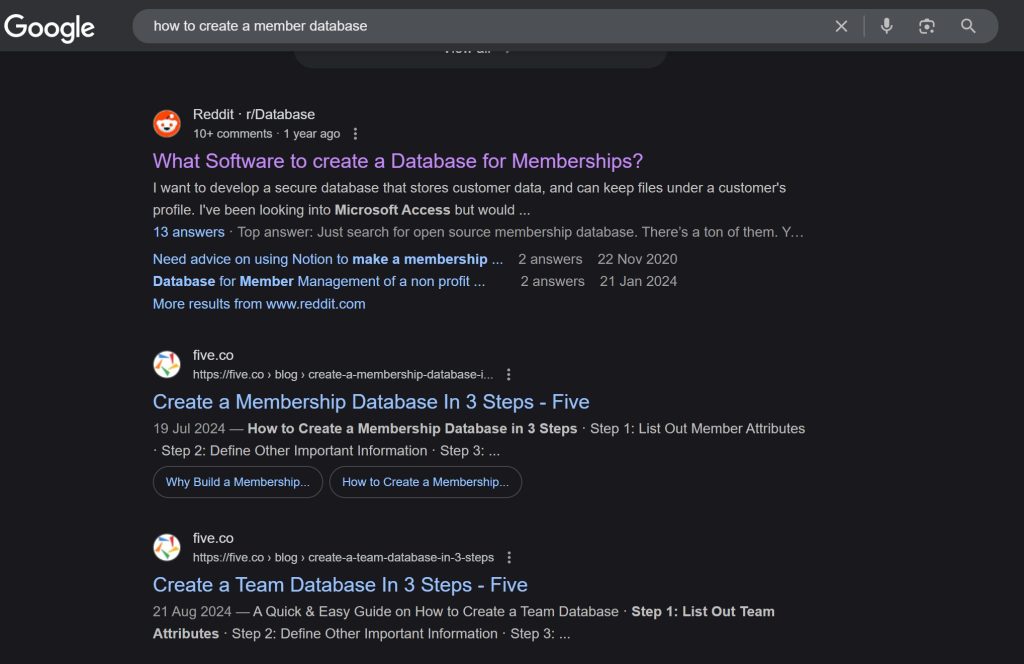
Because a lot of these keywords are very niche and long-tail, we ranked on Google’s first page almost immediately. And because each one of these blog posts is very similar to the next, we could work with patterns where we only had to do minimum content adjustments to publish new content.
By using topic variations and patterns, instead of spending hours writing individual blog posts, we mass produced posts at scale. Through the sheer volume of our publishing, our traffic also started to increase more quickly.
One word of caution: you can implement a mass publication strategy on day 1, but be careful. Google is very good at detecting spam, and if you start with zero domain authority and mass produce similar sounding blog posts at scale on day 1, you run the risk of not being indexed at all.
Tip 2: Go Deep Into Topic Areas
Whereas tip 1 suggests going wide (i.e. define a pattern for a blog post, and then publish every possible variation of the topic), our second tip for rapid traffic growth is to go deep.
In this phase of our growth, we realized that for some topics, we had barely scratched the surface. There are near infinite ways to go deeper into a topic area.
To give an example in relation to SQL, a popular database language:
- We first published blog posts such as “What is MySQL?“, a very broad and difficult to rank keyword.
- We then went one level deeper and published blog posts on more specific SQL topics, such as “The Best MySQL Tutorial” or “The Five Best Books on MySQL“.
- In the rapid growth phase of our website, we went one level deeper still: we mass published blog posts on specific SQL commands (there are a lot), such as “SQL CASE WHEN COUNT: Practical Guide with Real-World Examples“.
The same logic can be applied to almost any topic. Let’s take running shoes as an example:
- Broad Topic: What are running shoes?
- Focused Topic: What are the best running shoes in 2025?
- Laser-Focused Topic: What are the best running shoes for 5km races?
Note how the last, laser-focused topic opens up the possibility of easy expansion.
You can replace “5km races” with “10km races”, “half marathons”, “marathons”, “triathlons”, “beginners”, or you could add an adjective to describe the running shoe such as “carbon-plated”, for “for males”, “for females”, or “for beginners”.
In other words, the more specific or narrow your topic, the easier it is to expand on it. Also note how the more focused your topic is, the more likely you are to reach a specific, conversion-ready audience.
The person searching for “what are running shoes?” might be searching for all kinds of reasons. From their search query, it is unclear whether they are likely to buy running shoes at any time soon.
The person searching for “what are the best running shoes for 5km races?”, on the other hand, seems to have an intention to buy. Specifity often translates into buyer intent, so going deeper into keyword areas is a great strategy for growing qualified traffic.
Summary: B2B SEO – Earning Clicks Through Strategic Blogging
By following and applying the lessons, tactics and tips above, we believe that online marketers can effectively grow website traffic! Remember: the key is discipline, consistency and being smart about how you approach SEO.
The worst place to start is what most people do: “to just start blogging”. Instead, come up with a plan first: structure your site for success. Define who you want to reach with your content. Understand the keywords your audience is interested in. Publish consistently for at least 3 to 6 months.
By following these tactics, your website will start earning clicks! And if you still have questions or need help, reach out to us and we’re happy to help you in your SEO journey!