


3 Simple Ways to Discover AI Citations
AI citations are the new currency of online traffic, transforming how digital visibility is measured. Rather than earning clicks from Google Search, website owners increasingly rely on AI mentions, recommendations and AI citations to get clicks. Interestingly, research seems to suggest that clicks coming from AI are more likely to convert, making these users especially valuable. Website visitors find an AI recommendation to be more authoritative than a top 3 position in Google Search, though there is a strong correlation between AI citations and traditional search positions. In short: AI tools and search assistants such as ChatGPT, Perplexity, Claude, and Gemini are now major gateways to products, services, and content
But how can you discover and measure AI citations? There are (at least) three ways: inside your CRM, by using Google Looker or Google Analytics, or by manual testing.
Why AI Citations are Important For Brands
With over 700 million active weekly users, ChatGPT has rapidly grown into the new de-facto gateway (and gatekeeper) for information online. According to research published by OpenAI, ChatGPT’s users primarily use ChatGPT an advisor: almost half of all messages to ChatGPT are “asking”, and more than approximately 70% of use is non-work related.
These usage patterns clearly demonstrate that in order to reach consumers, buyers or customers, brands need to be visible in AI Search (click here for tips on how to rank in ChatGPT).
With the rise of AI-driven search, traditional search (i.e. Google’s “ten blue links”) is disappearing. Of course, even Google itself has responded to the growing trend of AI-driven search, putting AI Overviews front and centre for many informational searches.
Not surprisingly, this means that impressions and clicks are no longer the only metrics to monitor as a marketer or website owner. AI citations and mentions are equivalent, if not more important, than traditional SEO metrics.
Let’s learn how to discover AI citations – here are 3 proven ways to discover whether your website gets mentioned by AI.
3 Ways to Find AI Citations
1. Finding AI Citations in Your CRM
Your CRM, at least when connected to your website via tracking codes, can display AI citations as a utm_source.
For example, the image below shows the action – “Viewed Web Page” – a contact stored in our CRM took. At the end of the URL, you can see that this contact (who later signed up on our website) discovered and was directed to a blog post on five.co from “/?utm_source=chatgpt.com“.

Using a CRM is an easy and quick way to determine on an individual level whether contact originated from AI or not. This knowledge can help guide the next steps in your sales funnel, such as personalizing follow-ups for users who arrived via generative AI tools. However, this is, of course, not a great way to find citations at scale or to determine long-term trends.
That’s why Google Analytics is usually an easier way to find AI citations. Let’s find out how.
2. Finding AI Citations in Google Analytics
Finding AI citations in Google Analytics is straighforward. Before we introduce the steps, let’s take a look at a screenshot of AI citations shown in a report in Google Looker.
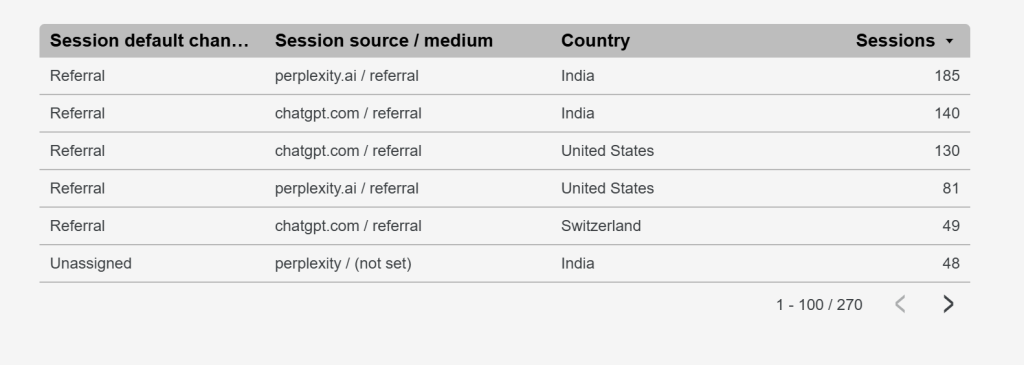
To find this data, connect your Google Analytics 4 to Looker Studio, and filter by “Session source / medium” and add the “contains” condition. In “contains” mention “‘chatgpt’, ‘perplexity’, ‘deepseek’, ‘gemini’, and ‘claude’.”, for example. This step is essential for tracking referral traffic driven by AI platforms within your analytics environment, capturing performance indicators from diverse AI-powered sources.
You can add other dimensions such as country as well. This gives you an overview of how many users from which country use what AI model to discover your website, products or services.
If you are not using Looker Studio, go to Google Analytics, and follow these steps:
- Click Reports,
- Then, Acquisition (User Acquisition or Traffic Acquisition)
- In the first column, filter ‘Medium‘.
Here’s what you should see:
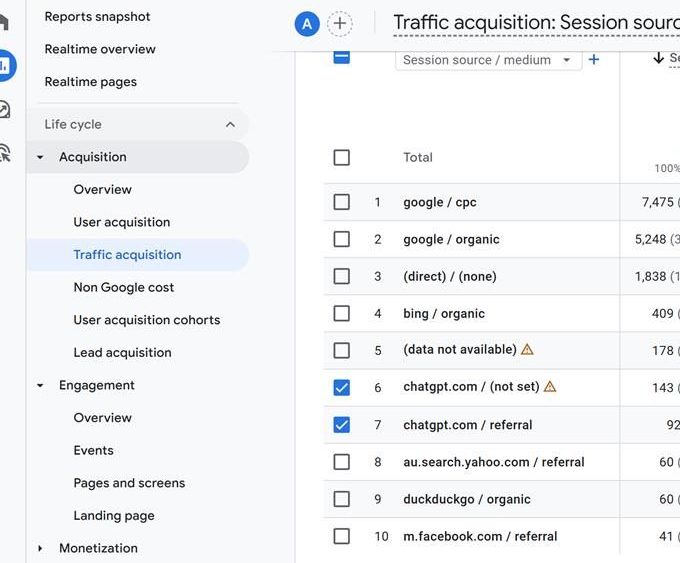
You can further filter by other LLMs. Add a filter that includes common AI models such as ChatGPT, Perplexity, Deepseek to find AI citations from each LLM.
As of the time of writing (late 2025), Google Analytics seems to be the most reliable free option to find AI citations. Other paid tools, such as SEMrush or Ahrefs, can help discover AI citations, but a paid subscription is required.
The last way to find AI citations is, of course, to discover them manually.
3. Finding AI Citations Manually
Finding AI citations manually requires you to go into each individual tool and prompting it with queries relevant to your brand or offering.
When doing so, our recommendation is to really put yourself in the shoes of someone who does not know your brand or business. When using AI to discover products or services, users ask. They don’t search. For example, someone might ask “can you recommend a plumber in Los Angeles?” or “what are the best headphones for running with great battery life”. As described here, it is important to “capture the wording users actually use, not your brand’s language“.
According to Search Engine Land, different AI models behave very differently for product recommendations: “ChatGPT and Google’s AI Mode and AI Overviews disagreed on brand recommendations nearly two-thirds of the time (61.9%)“. Some AI tools tend to mention brands pro-actively and frequently. Others rarely mention brands.
Also note that a “mention” and a “citation” are not the same: your brand may be mentioned without an AI citation. Whilst a mention is great, a citation can bring you direct clicks.
Testing different AI tools for mentions or citations every month is essential to analyzing AI citations. A good understanding of citations and mentions can inform your SEO strategy: are there content areas you should double-down on to strengthen your position? Is your brand not being mentioned/cited in areas where you wish to be mentioned/cited?
These questions can inform your content pipeline. However, bear in mind that LLMs can cite different webpages depending on the user, the conversational context, and other factors, so what you see may not be what other users see.
AI Citations: The New SEO Metric
Are AI citations the new SEO metric that counts? Probably. For businesses, earning a recommendation or citation in these tools can offer unprecedented exposure and an authoritative form of endorsement that extends beyond standard SEO rankings
As stated above, research suggests that website visitors coming from AI are more likely to convert. According to research by SEMrush, “the Average LLM Visitor is Worth 4.4x the Average Traditional Organic Search Visitor, based on conversion rate“.
That does not mean that traditional SEO is dead. Just on the contrary: content is what feeds AI. Without content, there are no AI citations or mentions. This puts brands without any online footprint at a disadvantage: “If your brand isn’t being discussed across the web already, it’s likely it won’t be included in AI Overview responses either.”
However, we believe that traditional clicks and AI citations will coexist for at least a few more years, and that eventually, as Google continues to update and embed AI into its search experience, new tools that give marketers more insight into AI citations, mentions and clicks will emerge. For now, the tools mentioned above – your CRM, Google Analytics and manual analysis – are essential to understanding AI citations.
As large language models and AI become further entrenched in the digital landscape, the role of AI citations will continue to evolve. Search engines and AI assistants are converging, and users increasingly look to conversational AI interfaces for recommendations about products, services, and information. For website owners and marketers, staying ahead in this transformation will require not just traditional SEO acumen, but also a deep understanding of how AI models choose and display their citations.